Summit II Recap: Building Trust in the Age of Agentic AI
Dear Friends and Colleagues,
A warm welcome to the roughly 2,000 of you who joined this list in recent weeks. You’ve arrived at a good moment.
On October 12, some sixty agency, brand, platform, legal, insurance, academic and regulatory leaders gathered at Omnicom in New York for Summit II of The Intention Advantage, The Elements of Intention: Trustworthy Advertising in the Age of Agentic AI. Summit I, in April, framed the problem. Summit II was charged with one question: what must be built?
The AI Advertising Trust Stack
The answer the day produced is a six-layer operating architecture, developed over two months by roughly forty participants in the six workstreams of the IEEE SA Industry Connections group chaired by IAE: Intention Alignment, Workforce Capability, Workflow Governance, Technical Conformance, Enterprise and Ecosystem Accountability, and Trust Performance and Lifecycle.
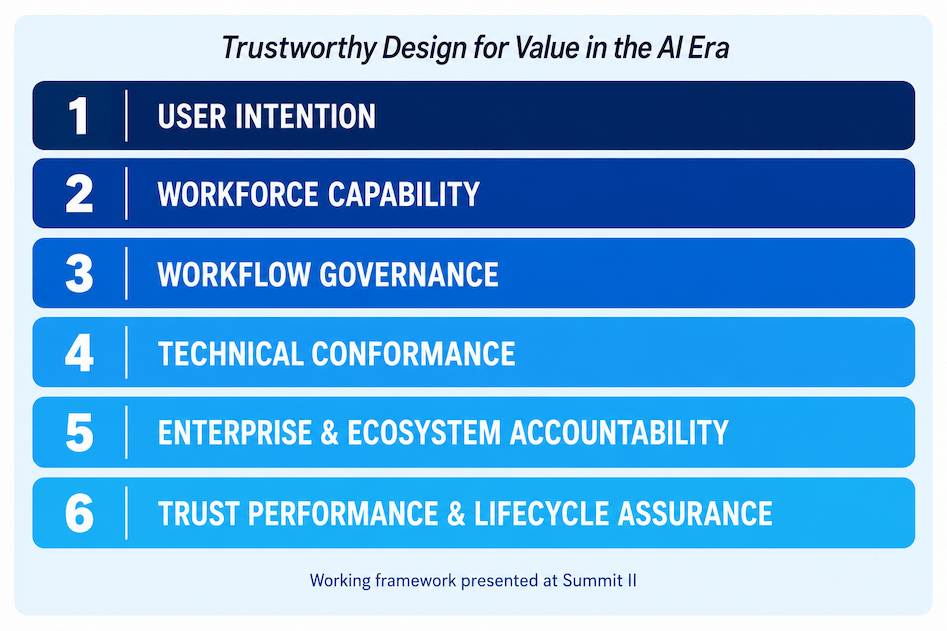
Each layer answers the same three questions: what problem must it solve, what must an organization have in place, and what remains unresolved. The room stress-tested it for a full day. The discussion affirmed the six-layer structure and identified where controls, evidence and accountability still need development. The day was honest about which. As one delegate put it, this is not a stack where a missing middle still stands. It is a Jenga pyramid.
The working North Star for Layer 1: The use of AI in advertising and marketing should not deceive, confuse, or mislead a reasonable consumer, or an agent acting on its behalf. That last clause was added from the floor. Consumer protection must also account for agents acting on consumers’ behalf.
Summit II Report — Available October 29
The full Report of the Institute for Advertising Ethics on Summit II, will present observations on the day’s four governing questions, the six Trust Stack layers, and priorities for the working groups.
Scenes and Conversations from Summit II

Selected conversations on what trustworthy advertising requires in the age of agentic AI.
AIRS is live, in beta
Aviation, medicine, finance and cybersecurity all learn from incident reporting. Advertising never has. The Advertising Incident Reporting System, built by IAE’s Ken Zinn and demonstrated at the Summit, is the first publicly inspectable record of advertising incidents anyone can look at.

Some numbers from the demo: AIRS ingests roughly 70 feeds every morning at 6 a.m., including FTC, CFPB, state attorneys general, NAD, BBB National Programs and CARU, then uses a large model to find what the feeds miss. In its first three weeks the de-duplication rate climbed from 70 percent to 94 percent. Every record is tagged against the IAE Principles and a risk taxonomy, stripped of editorializing language, and threaded to its canonical incident from first report through response, lawsuit or settlement. A certified human reviews and commits every entry. The AI suggests; it does not decide.
AIRS is in beta and we are looking for testers. If you would like to join, email info@iaethics.org.
With thanks
To Michael Horn and Omnicom for hosting; to Zefr, our inaugural sponsor, for modeling support that respects editorial independence; to the workstream leads, Heather Salkin, Mark Avnet, Michael Horn, John Matthews, Jay Mandel, Sean Meier, Basil Puglisi and Bettie Louie; to the ANA’s Michael Donnelly, who told the room “you are leading the way” and to MediaPost’s Joe Mandese for the reality check the day needed.
Stay Involved
Whether you want to join a workstream, request the report, test AIRS, pursue certification, or simply be first to hear about Summit III, one address covers all of it: info@iaethics.org. Tell us what interests you and we will take it from there.
Best,
The Institute for Advertising Ethics
Share